How to Choose the Right Buyer for Your Security Company
Who Gets the Songs: Choosing the Right Buyer for Your Security Company
Bob Dylan sold his life's work. So did Springsteen. The price made the headlines. The decision they actually agonized over was who.
I've been watching musicians sell their lives.
In December 2020, Bob Dylan sold his entire songwriting catalog — some six hundred songs, sixty years of work — to Universal for a reported sum north of $300 million. A year later Bruce Springsteen sold his catalog to Sony for a figure widely reported around half a billion dollars. After that the floodgates opened. Neil Young. Stevie Nicks. Half the Rock and Roll Hall of Fame, it seemed, cashing in the songbook.
The headlines were always the number. The number is easy to write about.
But the number was never the hard part. For an artist with that kind of catalog, the price was always going to be enormous. The decision that kept them up at night was the other one. Who gets to own the songs. Who decides where "Born to Run" plays for the next fifty years. Who they hand sixty years of work to.
I run NextGen Live Security, a HoldCo building a platform across the security industry. So I didn't read those deals as entertainment news. I read them as the cleanest case study I've found for an owner thinking about selling a company. Because if you own a security business, you own a catalog. And one day, you will choose who gets the songs.
Here is the part nobody tells you: the price is a number you negotiate once. The buyer is a decision you live inside for a decade.
This is for the owner of a security company — guarding, alarm, monitoring, integration — who is starting to think about an exit, and wants to think clearly about who should be sitting on the other side of the table.
Your Company Is a Catalog, Not a Job.

A songwriter spends thirty years working and ends up with a catalog — a body of work that throws off royalties whether or not he ever writes another line. The catalog is an asset. It exists independent of the man.
Most security owners never quite make that mental move.
They run the company as a job. A very good job, one that pays them well every year. The paycheck is real, and it feels like the point. But the paycheck quietly hides the thing that actually matters.
Your company is a catalog. Every contract you've signed, every account that renews on the first of the month, every block of recurring monthly revenue, every relationship with a property manager or a general contractor or the local fire marshal — each one is a song in the catalog. Together they have a value that exists separate from the salary you draw.
The day you decide to sell, you stop being the songwriter and become the owner of a catalog choosing its next custodian. The whole game changes.
Why this matters if you own a security company: until you see the catalog, you'll evaluate buyers the way a man compares paychecks — biggest number wins. Once you see the catalog, you start asking the question that actually decides your next decade. Who should own the songs, and what will they do with them.
Key Insight — Map vs. Territory. The salary you draw is the map of your company's worth. The catalog — the contracted, recurring, transferable cash flow, and the trust underneath it — is the territory. Spend a whole career reading only the map and you'll misjudge the territory the one time it truly counts.
The Major Label Will Pay the Most — and Take Your Name Off the Door.
When a major label buys a catalog, it pays top dollar. It can afford to, because it can do things with those songs you never could — sync them into films, bundle them, push them through a global machine. The industry word for that is synergy.
In your world, the major label is the strategic buyer. A larger competitor. An adjacent player — a guarding firm buying your alarm book, an integrator buying your monitoring operation. They can pay the highest headline number because your overhead becomes their savings. They close fast. They already understand the industry, so diligence is shorter.
That is the real, honest case for a strategic sale. Now understand what synergy means in plain English.
It means your back office is redundant.
It means the name on your trucks gets repainted inside eighteen months.
It means your longest-tenured people — the ones who built this with you — are precisely the ones the buyer's model is quietly counting on letting go. That is not cruelty. It is arithmetic. It is the synergy they paid you for.
And if the deal carries an earnout, a strategic buyer often ties it to integration outcomes — cross-sell targets, retention metrics — that you no longer control the morning after closing.
Why this matters: a strategic sale can be exactly the right move. If your single, honest priority is the highest possible number and a clean walk-away, you should welcome strategic buyers into a competitive process and chase that number hard. Just walk in clear-eyed about the trade. You are selling the catalog to someone who bought it to absorb it — not to keep it singing under your name.
Key Insight — Second-Order Thinking. The first-order result of a strategic sale is the biggest check. The second-order results — the name, the team, the customers, your reputation in a town where everyone knows you — are the ones you will actually live with. Negotiate the second-order terms as hard as you negotiate the first-order price.
The Fund Buys the Catalog to Sell the Catalog.
A lot of the catalog buyers in that gold rush weren't labels at all. They were funds.
The most famous, Hipgnosis, raised enormous capital and bought songs aggressively, treating catalogs as a financial asset class to be assembled and traded. For a while it looked unstoppable. Then came the hard part — painful writedowns, restless investors, and ultimately the fund itself being sold off. A big buyer paying a big number, it turned out, is not the same thing as a buyer who was right.
Private equity is the fund. PE buys your company as a "platform" or a "tuck-in," grows it for a defined window — usually three to seven years — and then sells it again. That is not a criticism of PE. It is simply the model, and the clock is structural. They are required to sell.
The upside is genuine. PE often brings strong total consideration: a healthy slug of cash plus rollover equity. And rollover equity is your second bite — the way you keep points on the catalog so you get paid again when the fund resells the larger company.
The cautions are just as genuine. Governance tightens — board approvals, reporting thresholds, decisions that used to take you an afternoon. The team gets "optimized," because efficiency is part of the investment thesis. And you are now on someone else's clock. In five years the company sells again, whether or not the timing suits you, your customers, or your people.
Hipgnosis is the reminder worth keeping. The second bite is real upside when the platform performs. When it doesn't, the second bite is a markdown.
Key Insight — Probabilistic Thinking. Don't ask whether the second bite will pay off. Ask what the full range of outcomes is, and how likely each one is. Rollover equity can be worth several times your cash at close — or a fraction of it. Size how much you roll so that even the bad branch of that tree is a future you can comfortably live in.
The Patient Owner Never Has to Sell.
There's a quieter kind of catalog buyer. The one who buys to hold. No fund life, no countdown, no obligation to flip. It grows value the slow way — by owning well, year after year, and letting it compound.
That is a HoldCo. A permanent-capital platform. Unlike a PE fund, a HoldCo is not structurally required to resell on anyone's timeline. It can think in decades.
That one structural difference changes the behavior all the way down.
A HoldCo usually keeps your brand — because in a trust business the local name is the asset it paid for, and repainting the trucks would be lighting money on fire. It tends to invest in the team rather than thin it, because it has to live alongside that team for a very long time. And it can offer you a genuinely flexible role — stay on, transition slowly, or step out — with rollover equity that gives you a real second bite.
Now the honest objections, because a guide that only flatters one option is a brochure, not a guide.
A HoldCo is usually a smaller buyer than mega-PE, which means it will rarely win a pure, maximum-price auction. It may bring less acquisition firepower than a giant platform. And — this is the one that matters most — the model does not guarantee the operator. A HoldCo is only ever as good as the people running it.
So diligence them harder than they diligence you. Ask to speak directly with the last three founders who sold to them. Ask what happened to those teams, and those brands, three years after the check cleared. Then believe what you hear, not what's printed in the deck.
Why this matters: if your definition of a good outcome includes the people and the name, and not only the size of the wire, the patient owner is built for exactly you. But "patient capital" is a category, not a character reference. Verify the operator.
Key Insight — Incentives. Show me the incentive and I'll show you the outcome. A buyer with a five-year fund clock and a buyer with no clock at all will make honestly different decisions about your brand and your people — not because one is virtuous and the other isn't, but because they are structurally pointed in different directions. Read the structure. It will tell you more than the promises.
The Collector Wants to Play the Songs Himself.
There's a fourth buyer at the door. Not a label, not a fund, not a platform. A single person who loves the catalog enough to want to own it and play it himself.
In the business world, that's the search fund. One entrepreneur — usually backed by a group of investors — who raises capital to buy a single company and run it personally. It is the heart of what's called Entrepreneurship Through Acquisition.
The appeal is real, and it's human. This is a true successor — someone who will live inside the business, walk the floor, learn the customers by name, rather than fold it into a portfolio and a quarterly report. They usually keep the brand, the team, the local identity. They are motivated the way only an owner can be.
The cautions are just as real. The searcher operates the company, which means you, as CEO, are stepping out — not staying on. The deals tend to be smaller; many searchers simply can't stretch to a larger price tag. The financing is often SBA-heavy and can be more fragile than institutional capital. And the entire plan rides on one individual, frequently a first-time CEO, carrying the weight of your life's work.
Why this matters: a search fund can be a genuinely beautiful outcome for a smaller company whose owner is truly ready to hand over the keys. Just underwrite the human being as carefully as that human being underwrites your company.
Key Insight — Single Point of Failure. A strategic, a fund, a HoldCo — each is an organization with depth behind it. A search fund is a person. That can be the warmest outcome on this entire list or the most fragile one, and the difference is, almost entirely, the individual. Diligence the operator as if the whole deal depends on them. It does.
The Headline Number Is Not the Royalty Check.
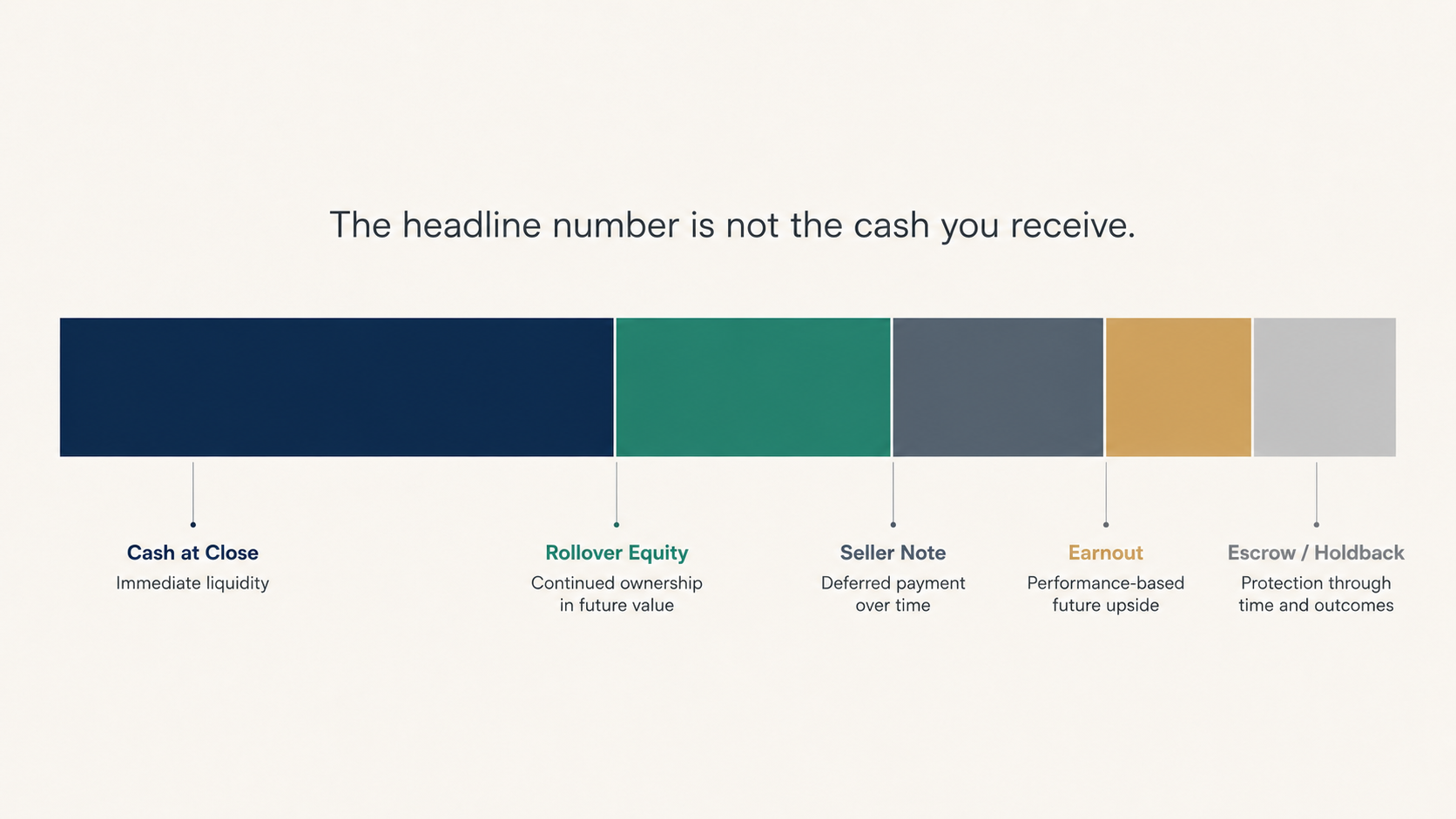
When the press reported a catalog "sold for $300 million," that is not the figure that hit the artist's account. There were structures, holdbacks, taxes, terms. There always are.
Two offers with the identical headline price can be wildly different deals. So learn the parts.
Cash at close is the money wired on closing day — the most certain dollars in the whole transaction. Rollover equity is the stake you keep in the new company — your second bite, and either your most valuable line item or your most disappointing one. A seller note is you financing part of the price yourself and getting paid over time; it bridges a valuation gap, but it parks your money behind the buyer's future performance. An earnout is a contingent payment tied to future results — and here's the line to remember: fight to tie it to financial metrics like EBITDA, which you can still influence, rather than to integration outcomes like cross-sell, which you cannot once your authority shrinks. Escrow is the slice held back against post-close claims; it's normal, but negotiate its size and its release date. And the working capital peg is the boring, technical item that quietly costs unprepared sellers six figures — make your advisor model it before you sign anything.
So never compare offers on the headline number. Compare them on risk-adjusted value: how much is certain, how realistic the earnout actually is, how credible the equity really is.
Key Insight — Margin of Safety. The gap between the headline number and the cash you can genuinely count on is your exposure. A deal that's 90% cash at close carries a wide margin of safety. A deal that's 40% cash and 60% "trust me" does not. Structure it so that even if the optimistic half never arrives, you still did just fine.
Rank Your Own List Before You Take a Single Meeting.
Here is the thing almost no owner does, and every owner should.
Before you take one buyer meeting, sit down and rank what you actually want.
Seven things usually belong on that list. The highest headline price. The certainty of the cash. Whether the brand survives. Whether your team keeps their jobs and grows. What your own role looks like the day after close. Whether there's a real, credible second bite. And whether you would be genuinely proud to have this partner's name standing next to yours in the town where you built this.
Rank them. Honestly — not how you think you should answer, how you actually feel. Then score every serious buyer against your ranking, not against each other's pitch decks.
The ranking does the work for you.
If "highest price" and "clean break" sit at the top, you are pointed straight at a competitive auction full of strategic buyers. Run one. Hire an advisor. Don't apologize for it. If "the name survives," "the team grows," and "a partner I'd be proud of" sit at the top, you are pointed at a HoldCo or a search fund — and the structure of the deal will matter as much as its size.
And there are paths I haven't dwelt on that may top your particular list — selling to your own management team, or to an employee ownership trust. Smaller headline number, usually. Maximum continuity. They belong on the list too.
Now the uncomfortable part, because an honest guide has to say it. If you read all of this and your ranking points you toward a strategic buyer and a loud, competitive auction — then that is the right answer for you, and a good advisor will tell you so even when they'd rather you picked them. The goal of this piece was never to win you. The goal is for you to choose well.
Key Insight — Inversion. Don't begin by asking which buyer is best. Begin by asking what would make this the wrong sale — the name gone, the team gutted, the cash that never showed up, the partner you grew to resent. Name the bad outcome first, in detail. Then choose the buyer least likely to deliver it.
Decide Who Gets the Songs.
Dylan didn't lose sleep over the number. Neither did Springsteen. The number was always going to be large.
What they weighed was who. Who would steward sixty years of work. Who would decide where the songs lived next, and how they'd be treated, and whose name would be attached to them long after the artist was done.
You will make the very same decision about the catalog you spent your life writing — every contract, every renewal, every hard-won relationship, every officer you trained and customer you kept. The price will get all the attention. The buyer is the part you actually live inside.
So do the unglamorous work. See the company as a catalog, not a job. Learn the four buyers and what each one is built to do. Rank your own list before anyone else hands you theirs. Read the structure, not the pitch.
For what it's worth, here is where we stand. NextGen Live Security is a HoldCo focused only on the security industry — live video monitoring and remote guarding, systems integration, access control, commercial fire and security alarms, perimeter security. We are the patient owner. No fund clock. We keep the name, we invest in the team, we build the platform around what you started, and we structure deals so you hold a real second bite.
If you want a confidential conversation about your options — no listing, no pressure, and an honest answer even when that answer is "go talk to a strategic" — that is exactly what we're here for.
You spent a lifetime writing the catalog.
Decide who gets the songs.